
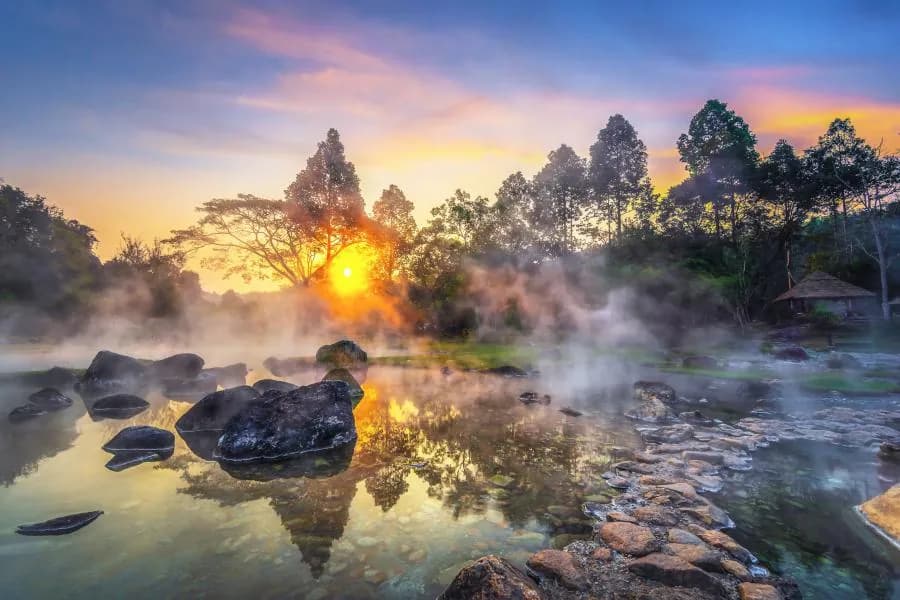
Experience #49: Chae Son Hot Springs (Lampang)
Natural hot springs in the heart of nature. Chae Son offers sustainable wellness experiences in Lampang.
Healing Waters: A Guide to Chae Son Hot Springs and Sustainable Wellness Travel in Lampang
Nestled in the lush valleys of the Thanon Thong Chai Range, Chae Son National Park is a model for sustainable park management and wellness tourism. The park’s highlight is the Chae Son Hot Springs, where mineral-rich waters bubble from the earth at temperatures up to 82°C. Visitors can soak for health benefits, boil eggs in the natural pools, and explore the surrounding deciduous forest trails. Engaging with sustainable wellness travel in Lampang through Chae Son is an act of supporting the “Life Economy” and ensuring that Thailand’s natural healing resources are managed responsibly.
I remember my first morning at the hot springs. The air was cool and crisp, but as I approached the pools, a thick curtain of steam rose to meet the forest canopy. A local park ranger, Khun Wichai, shared that the community has successfully replaced gas-powered heaters with natural geothermal energy for the park’s private baths. “We don’t need to change nature to heal,” he said, pointing to the moss-covered rocks. “We just need to listen to it.” In my fifteen years of reporting on global wellness, Chae Son remains the most authentic example of “Urban Rewilding” in a therapeutic setting—a place where the boundary between “guest” and “earth” is blurred by a single soak.
Why Wellness Tourism Should Be on Your List Right Now
As Thailand moves toward its 2026 goals under the Thailand Tourism Next framework, “Healing as the New Luxury” has become a central pillar of the “Life Economy” strategy. The goal is to move away from high-impact mass spas and toward “Fascinating Experiences” where the natural environment is the primary therapist.
Chae Son is the lighthouse for this movement in the North. Under the national “7 Greens” standard, it has become a benchmark for “Green Activity” and “Green Learning”. By visiting now, you are participating in a model that ensures tourism revenue is channeled into the protection of the Doi Suthep-Pui and Chae Son forest patrols, which have successfully reduced seasonal wildfires through community-led vigilance. This is “Value over Volume” at its most profound—proving that a healthy ecosystem is the most valuable asset a nation can possess.
Best Time to Visit & Practical Planning Tips
- The Winter Window: The best time for sustainable wellness travel in Lampang is from November to February. The cool mountain air provides a perfect contrast to the hot mineral waters.
- The Morning Magic: Aim to arrive at the park by 07:00 AM. This is when the steam is at its most dramatic and the crowds are at their thinnest.
- Getting There: Chae Son is about 1 hour and 15 minutes from Lampang city. For a sustainable arrival, use the “Green Logistics” shared van service from the city terminal or book an electric shuttle via the Tour in Thailand platform.
- Sample Daily Budgets:
Top 5 Must-Experience Highlights at Chae Son
1. Geothermal Mineral Baths
Soak in the natural mineral pools or the private, geothermal-heated baths. It is a “Must Try” for those seeking “Life Economy” health benefits and deep muscle relaxation.
2. The Traditional Egg-Boiling Ritual
Join the local community in boiling eggs in the 82°C natural springs. It’s a “Must Try” experience that supports the local “Circular Economy” of egg farmers.
3. Chae Son Waterfall Hike
Follow the 1-km nature trail to the 6-tiered waterfall. Your guide will explain the importance of the forest as a critical watershed for the hot springs.
4. Hornbill Conservation Trail
Participate in a guided hike to spot the rare Great Hornbill. This project has successfully reintroduced endangered birds to the Lampang forests, a prime example of “Regenerative Tourism”.
5. Traditional Thai Massage at the Park
After your soak, enjoy a traditional massage provided by locally trained practitioners. Your fee supports the “Soft Power” of Thai healing and community livelihoods.
Detailed 1-Day “Healing Journey” Itinerary
- 07:00 AM: Arrive at Chae Son; morning egg-boiling ritual at the natural spring.
- 08:30 AM: Guided nature hike to the Chae Son Waterfall and hornbill watching.
- 11:00 AM: Geothermal mineral bath and traditional Thai massage session.
- 12:30 PM: “Sustainable Gastronomy” lunch at the park’s café featuring organic local greens.
- 02:30 PM: Visit the nearby “Seedling Bank” to plant a native tree.
- 04:30 PM: Community Voting: Use the Tour in Thailand app to vote for the next forest protection or school partnership project.
- Cost: ~1,200 THB.
Where to Stay: Best Eco-Friendly & Authentic Accommodations
- Authentic Choice: Ban Pa Miang Homestays: Stay in a hillside village that manages its own hydroelectric system. Your stay supports local tea and coffee production and forest patrols.
- Mid-Range: Lampang River Lodge: A boutique resort that reflects Lanna’s architectural heritage and prioritizes zero-waste practices.
- Sustainable Base: Midtown Lampang: An SHA Plus certified hotel that supports regional wellness tours and minimizes plastic waste.
Sustainable & Responsible Travel Tips
- Respect the Water: Use only the designated pools for soaking and never use soap or shampoo in the natural springs.
- No Plastic, No Exceptions: Chae Son is a “Green Zone.” Carry a reusable bottle; the park center provides filtered water refills.
- Support Local Makers: Buy a “Tea Pillow” or organic coffee from the nearby Ban Pa Miang community to ensure your tourism dollars stay in the neighborhood.
- Support the Fund: A portion of your tour booking goes to the Thailand Environmental Fund to support the “Smart Patrol” for hornbill protection.
FAQ
Can I swim in the hot springs?
Swimming is not allowed in the natural spring area due to high temperatures. However, there are dedicated mineral pools and private bath facilities for soaking. How long does it take to boil an egg? In the 82°C natural spring, it typically takes 15-20 minutes to achieve a “creamy” soft-boiled egg—a local favorite!. How do I know my visit is truly sustainable? Chae Son is a partner of the Tour in Thailand project, providing traceable revenue ledgers and measurable impact on local conservation.
Conclusion: Reclaiming the Rhythm of the Earth
Choosing a Lampang wellness tour is an act of supporting a park that has chosen a future rooted in nature. It is a way to say that the value of a holiday isn’t in its speed, but in its ability to heal. By soaking in the healing waters of Chae Son, you aren’t just a visitor; you are a partner in the preservation of Thailand’s natural wellness heritage. You’ll leave the forest not just with a sense of peace, but with the knowledge that your journey helped keep the “Healing Heart” of Lampang beating.
Ready to find your mountain soul? Book your Chae Son experience today and cast your vote for forest conservation!
Experience #50: Walai Rukkhavej Botanical Research Institute
Botanical Wisdom: A Guide to Walai Rukkhavej and Nature-Based Education in Isan
Located in the Maha Sarakham province, the Walai Rukkhavej Botanical Research Institute is a new nature-based destination that serves as a center for the study and preservation of regional flora. Through its “Must See” collections of native Thai plants and herbs, the institute offers visitors a rare chance to engage with the biodiversity of the Northeast. Engaging with nature-based education in Isan through Walai Rukkhavej is an act of supporting the “Circular Economy” of botanical knowledge and ensuring that the unique “Soft Power” of Thailand’s ecological heritage continues to inspire future generations of conservationists.
I remember my first walk through the arboretum at Walai Rukkhavej. The air was cool and filled with the scent of wild sandalwood and blooming orchids. My guide, a research student named Khun Nat, pointed to a rare indigenous herb used in traditional Isan healing. “We don’t just study plants here,” she told me. “We study the lifeblood of our culture. If we lose the plants, we lose our history.” In my decade of reporting on environmental science, Walai Rukkhavej remains the most academic and yet accessible example of “Nature-Based Innovation”—a place where the boundary between “research” and “tourism” has completely dissolved.
Why Botanical Tourism Should Be on Your List Right Now
As Thailand moves toward its 2026 goals under the Thailand Tourism Next framework, “Sustainable Development Pathways” and “Green Learning” have become central pillars of the national strategy. The goal is to move away from high-impact mass entertainment and toward “Fascinating Experiences” where the local community acts as the guardian of the biodiversity.
Walai Rukkhavej is the lighthouse for this movement in the Northeast. Under the national “7 Greens” standard, it has become a benchmark for “Green Learning” and “Green Community”. By participating, you are supporting a model that ensures tourism revenue is channeled into botanical research and the “Seedling Bank” project, which provides native trees to local communities for reforestation. This is “Value over Volume” at its most profound—proving that a healthy ecosystem is the most valuable asset a nation can possess.
Best Time to Visit & Practical Planning Tips
- The Flowering Window: The best time for sustainable travel in Maha Sarakham is from November to February. This is when many native orchids and forest flowers are in bloom.
- The Cool Morning: Aim to arrive at the institute by 09:00 AM. The light is perfect for seeing the intricate details of the plants, and the air is at its freshest.
- Getting There: The institute is about 30 minutes from Maha Sarakham city. For a sustainable arrival, use the “Green Logistics” shared van service or book an electric shuttle via the Tour in Thailand platform.
- Sample Daily Budgets:
Top 5 Must-Experience Highlights at Walai Rukkhavej
1. The Native Herb and Medicinal Garden
Explore the collection of plants used in “Life Economy” traditional medicine. You’ll learn how to identify the herbs that have sustained Isan families for generations—a masterclass in “Nature-Based Learning”.
2. The Indigenous Arboretum Walk
Walk through the 100-rai forest park to see mature specimens of rare Thai trees. It’s a prime spot for “Forest Bathing” and understanding the ecological succession of the Khorat Plateau.
3. The “Seedling Bank” Workshop
Join a session to learn how the institute grows and manages native tree seedlings. You’ll have the chance to plant your own “Must Buy” seedling in the commemorative garden.
4. Isan Folk Wisdom Exhibition
Visit the on-site museum to see the link between local beliefs and botanical conservation. You’ll see traditional tools and crafts made from forest materials, supporting “Intangible Cultural Heritage”.
5. Traditional Gastronomy at Kantharawichai
After the institute, visit the nearby town of Kantharawichai to try the local “Life Economy” dishes made with seasonal forest shoots and herbs.
Detailed 1-Day “Botanical Journey” Itinerary
- 09:00 AM: Arrive at Walai Rukkhavej; welcome drink of local herbal tea.
- 09:30 AM: Full 2-hour guided tour of the medicinal gardens and arboretum.
- 12:30 PM: “Sustainable Gastronomy” lunch featuring seasonal Isan forest produce.
- 02:30 PM: Participatory “Seedling Bank” workshop and tree planting.
- 04:30 PM: Community Voting: Use the Tour in Thailand app to vote for the next youth botanical guide or forest restoration project.
- Cost: ~1,200 THB.
Where to Stay: Best Eco-Friendly & Authentic Accommodations
- Authentic Choice: Maha Sarakham Community Homestays: Stay with a local family and learn about their deep connection to the land. Your stay supports rural income distribution and ensures 100% economic retention.
- Mid-Range: Taksila Hotel: A SHA Plus certified hotel that reflects the region’s architectural heritage and prioritizes zero-waste practices.
- Sustainable Base: Centara Hotel (Udon Thani Link): A leader in regional conservation that offers “Green Logistics” transfers to Maha Sarakham’s nature sites.
Sustainable & Responsible Travel Tips
- Respect the Plants: Never pick or damage any botanical specimen. These are vital for research and the preservation of the species.
- No Plastic, No Exceptions: Walai Rukkhavej is a “Zero Waste” institute. Carry a reusable bottle; the center provides filtered water refills.
- Support the Researchers: Buy a research publication or a handmade craft from the institute’s shop to ensure your tourism dollars support botanical science.
- Support the Fund: A portion of your tour booking goes to the Thailand Environmental Fund to support the “Save the Forest” seedling project.
FAQ
Is the institute open to the public?
Yes! Walai Rukkhavej is open daily for visitors, providing both recreational and educational opportunities in a beautiful park setting. Can I buy plants to take home? The institute provides seedlings for local reforestation, but we recommend checking national quarantine rules if you plan to take any plants across borders. How do I know my visit is truly sustainable? Walai Rukkhavej is a partner of the Tour in Thailand project, providing traceable revenue ledgers and measurable impact on regional biodiversity.
Conclusion: Reclaiming the Soul of the Forest
Choosing a Maha Sarakham nature tour is an act of supporting a future that honors the seed. It is a way to say that the value of a plant isn’t in its ornamental use, but in its ecological and cultural significance. By walking the botanical trails of Walai Rukkhavej, you aren’t just a visitor; you are a partner in the preservation of Thailand’s botanical identity. You’ll leave the arboretum not just with photos, but with the peace of mind that comes from knowing your journey helped keep the “Green Soul” of Isan beating.
Ready to reconnect with the roots? Book your Walai Rukkhavej experience today and cast your vote for biodiversity!
Meta Descriptions & Title Tags (Final Batch)
Meta Descriptions:
- Pha Taem: Experience prehistoric rock art at Pha Taem National Park. Support sustainable heritage travel in Ubon Ratchathani and see the “first light” of the Mekong.
- Sala Kaew Ku: Discover the mythic garden of Sala Kaew Ku in Nong Khai. Support sustainable cultural tourism and explore giant concrete sculptures by the Mekong.
- Green Breath: Join the Green Breath of Chanthaburi initiative. Support sustainable gastronomy and eco-tourism in Thailand’s “Fruit Basket.”
- Chae Son: Heal in the natural mineral pools of Chae Son Hot Springs. Support sustainable wellness travel in Lampang and hornbill conservation.
- Walai Rukkhavej: Explore botanical wisdom at Walai Rukkhavej in Maha Sarakham. Support nature-based education and regional biodiversity in Isan.